Created with AI

For team leads and business owners

Stop firefighting
from the beach

The best handover is a team that can think for itself. Buoyed by the quiet hope that it keeps growing without you.

Prepare your team to decide boldly — so priorities, customer issues and invoices never need damage control.

Playable in
7 minutes
Progress between
rounds is
measurable
Impact on team
and business
made traceable

Round result

Round 2 of 2

Change between rounds

Response time to key information−32%
Open work identified+48%
Decision input (avg. per person)+31%
Team impact+28%
Focus under pressure−18%

Data from your own team – not from a benchmark.

Christina Beck Scrum Master & Agile Coach

Scrum Masters and Agile Coaches are testing FlightRoom ahead of everyone else — with their real teams, in real sessions.

Currently in pilot phase

Your holiday thief

This is where the thinking breaks.

Processes, delegation and cover all help.
They just do not solve your actual problem.

1.What you secure today

  • Processes & checklists They create clarity and standards – as long as everything goes to plan.
    Standards get written down so tasks can be handed over cleanly. The problem: Unexpected situations are rarely in the checklist.
  • Delegation It spreads ownership and decisions – in stable situations.
    Decisions get handed to team leads or subject owners. The problem: Ownership on paper does not mean it gets taken when things are uncertain.
  • Cover It absorbs absences and keeps the day running – as long as things stay predictable.
    Backups and stand-ins get named for the critical areas. The problem: When information is missing or areas collide, it escalates upwards anyway.

This matters. It is just not enough.

The break

When it gets critical,
structure is not what decides.

What decides is the quality of the decisions.

2.What actually counts

  • Raise risks early Notice the weak signals and say them out loud.
  • Decide under uncertainty Stay able to act, even when not everything is clear.
  • Organise help in time Bring in the right people and resources.
  • Take ownership day to day Make the call and stand behind the outcome.

This is what makes the difference. Especially under pressure.

What nobody wanted to hear, until it crashed

How firefighting builds up, step by step.

Aviation found exactly this chain when it analysed serious accidents.
That is how Crew Resource Management came about.

Sources: Tenerife final report · NTSB AAR-79-07 (United 173) · NASA CP-2120 (1979 workshop)

The diagnosis: a causal chain

From silence to firefighting

How small, unspoken doubts turn into operational chaos.

  1. 1

    Uncertainty goes unspoken.i

    Speaking up costs something visible right away: holding up the room, looking unsure, correcting someone. Staying quiet costs nothing in that moment. So the call is made on the risk of the moment, not on what people know. Day to day: Someone has a bad feeling in the meeting – and says so afterwards by the coffee machine.

    Example in business

    Open questions in the project never make it into the meeting.

  2. 2

    So there is no shared picture.i

    Everyone takes their own picture for the complete one. Missing information does not stand out as long as nobody says it out loud — you cannot notice what you do not know. Day to day: A customer flags a risk by email, but the project team hears about it days later.

    Example in business

    Marketing plans on different numbers than sales and product.

  3. 3

    Decisions are made too late, in isolation or defensively.i

    Whoever decides under uncertainty carries the risk visibly. Whoever waits or asks back does not. Hesitating is sensible for the individual — and expensive for the team. Day to day: Everyone waits for the go-ahead – until the deadline has passed or the risk has landed.

    Example in business

    Decisions get made one-to-one instead of in the team.

  4. 4

    What you see day to day: firefighting.i

    The bill arrives weeks later and somewhere else. Nobody connects it to the sentence that went unsaid back then. That is why the pattern never corrects itself. Day to day: Help gets asked for once it is already burning – not when it is about to.

    Example in business

    Ad-hoc meetings, plan changes and overtime start piling up.

How FlightRoom works

Why ONE workshop is not enough.

What matters does not happen in a single moment of insight.
It happens in a cycle that shifts perception, names the hurdles and settles new behaviour into everyday work.

What the goal is NOT

  • not knowing every bit of the boss’s context
  • not carrying every consequence yourself
  • not copying instructions blindly

What your team learns instead

  • Build knowledge before someone drops out Not starting to learn once you are away.
  • Take ownership before it burns Not waiting until you have to step in.
  • Work out how something is done The way you learned it as the boss, too.
  • Make the call and stand behind it Not passing every doubt back up the line.

A serious game that turns perception into action.

Teams live real dynamics in play, spot the patterns in the debrief
and carry better responses into everyday work.

189 dead?

  1. 1 Start the scenario A realistic trigger and a clear target picture.
  2. 2 Act under pressure Decide, communicate and prioritise as a team.
  3. 3 Make consequences visible Patterns, bottlenecks and responses become tangible.
  4. 4 Understand it in the debrief Review together, make sense of it and name what happened.
  5. 5 Carry it into everyday work Concrete behaviour anchors, next steps and transfer.

From contact person to team lead

From a team that works
to a team with mastery.

FlightRoom makes team dynamics visible, decisions more effective
and collaboration your competitive edge.

Measurably better. Every round.

  • +31%

    Decision input

    after two rounds

  • +28%

    Even participation

  • −42%

    Misunderstandings

    in the team

  • +19%

    Delivery performance

    in the next project

Your path to mastery.

  1. 1 Clarity A shared understanding of goals and decisions.
  2. 2 Ownership Everyone actively takes ownership – day to day.
  3. 3 Coordination Better aligned, faster in flow.
  4. 4 Composure Decide with routine. Under pressure, too.

The result: a team you are proud of.

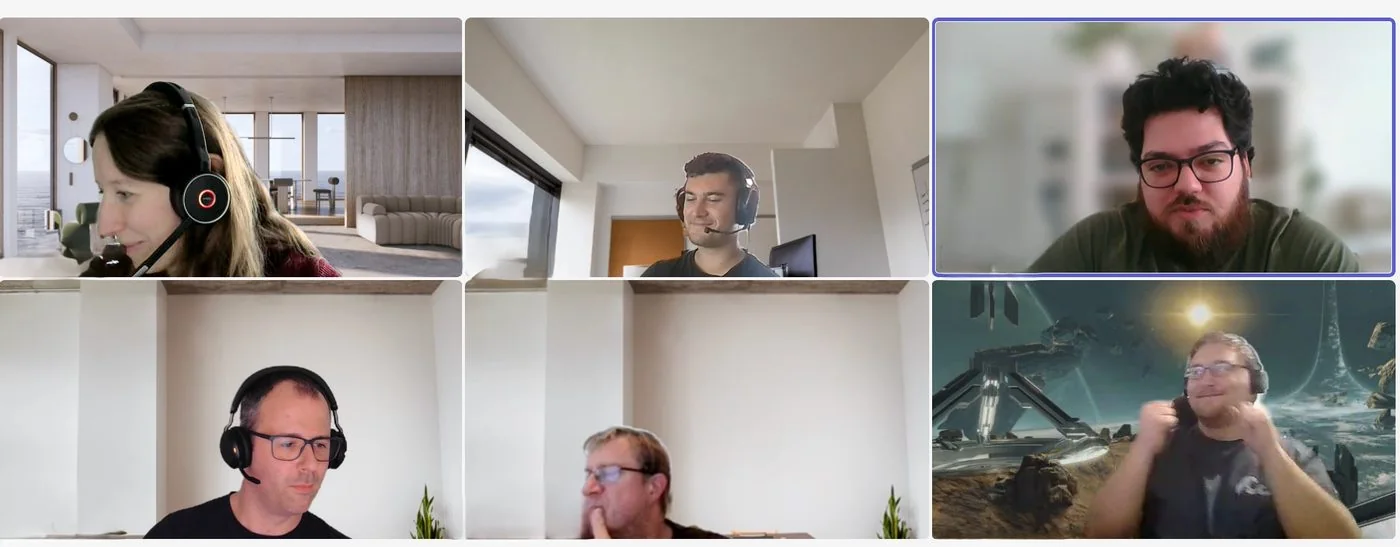
Six participants in a FlightRoom session over video conference, most of them wearing headsets.

From the pilot phase

One of the first teams to try FlightRoom in a real session.

Christina Beck — Scrum Master & Agile Coach

Backed by research.

Research shows that team processes such as information sharing, clear roles and psychological safety are directly linked to performance, quality and decision quality.

Learn more

Meta-analyses

A meta-analysis covering studies with thousands of teams shows positive links between team processes and performance outcomes.

LePine, Piccolo, Jackson, Mathieu & Saul (2008): A Meta-Analysis of Teamwork Processes. Personnel Psychology 61(2).

Read the study

Psychological safety

Made famous by Google's Project Aristotle and backed by research: teams whose members can speak up learn faster and work together more effectively.

Frazier, Fainshmidt, Klinger, Pezeshkan & Vracheva (2017): Psychological Safety — A Meta-Analytic Review and Extension. Personnel Psychology 70(1).

Read the study

Transparent & honest

This research establishes the link. With FlightRoom you make the concrete effect visible and measurable in your own pilot.

Your next holiday will come.
Will your team be ready?

Good decisions do not grow overnight. Will you start before take-off?

Start now with your team

149 € per monthinstead of a one-off €299

Takes about 15 min.

  • Spot the gaps
  • Get clarity
  • Set priorities
  • Strengthen your team
Made in Germany GDPR-compliant ISO 27001-certified hosting No installation required