User Story: True Collaboration Isn't Just About Filling Gaps
Last summer, right in the middle of vacation, I suddenly found myself not on the beach, but in front of my laptop. "The deadline is August 31st," Steffi said, and that's when the chaos began. We were cut off from the webshop, and the works council was supposed to help us. But the solution?
Manual entry. One hour per order.
As a works council member, I was used to addressing colleagues' concerns and finding compromises with management. Normally, this meant sitting in meetings and presenting issues, but this summer was different.
The vacation with my three kids was supposed to be a relaxing time, yet there I was, sitting at the kitchen table with my laptop.
When the reactor exploded
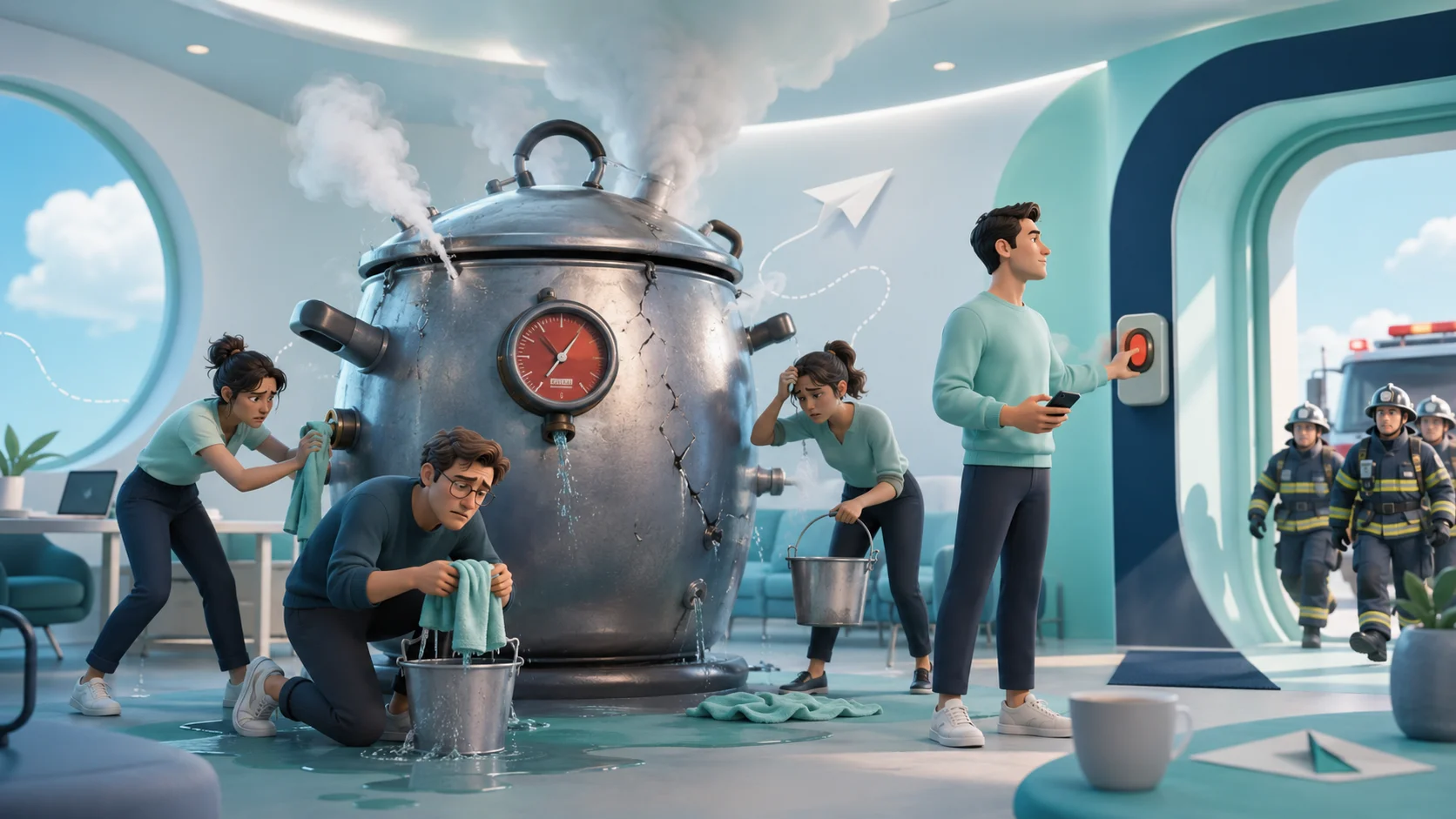
The company I work for produces pharmaceuticals. A complex process requiring precision and collaboration. But problems arose when a company tasked with producing the precursors of our products failed to synthesize them correctly. The reactor exploded, and the fire truck caught fire as well.
A disaster that shook our entire system.
And then there was the webshop, which we no longer had access to. The solution? We were to manually enter orders. Suddenly, it took an hour per order. The situation was frustrating, yet management seemed to have no better solution.
So there I was, with my laptop during summer vacation, trying to manage work while my kids played in the background.
The task force met into my holiday
The task force that was created was supposed to help. The idea: We find a way to improve processes together. But the more I got involved with this group, the clearer it became how chaotic everything was. The CEO led the meetings, which fell during my vacation.
Meanwhile, my kids were running around, and I was trying to focus on the discussions.
A fundamental problem was that many decisions were made by people who knew little to nothing about our industry. A cost-cutter from the automotive industry was brought in to show us how to work more efficiently, but he had no clue about chemistry.
This incompetence was reflected in the poor decisions that had landed us in this situation.
When the whole building carried the load
Our work process used to be clearly structured. Orders in the lab were handled by three to four people per lab. But now the responsibility lay with us, the entire company. I had to explain to the French in purchasing why we could no longer order as before.
Trying to bring order to this chaos pushed me to my limits.
The turning point
The turning point came when I realized that my role as a works council member did not oblige me to cover for the top management's mistakes. Yes, it was my job to represent the employees' interests, but not at any cost. I had to draw the line between responsibility and exploitation.
Drawing the line
I decided to set clear boundaries. Vacation should not be working time. The task force was important, but not at the expense of my rest and my family. I made demands: Either the vacation was compensated, or I would no longer step in when management failed.
This decision fundamentally changed my perspective. I realized that I am not just a works council member, but also a person with rights and needs. The clarity I gained made me stronger in my role and helped me better advocate for the employees' concerns.